Why Do Saskatchewan Whitetail Grow So Large at Mistatim Outfitting?
If you have ever seen photos of mature Saskatchewan Whitetail bucks, you may have wondered how these deer get so big.
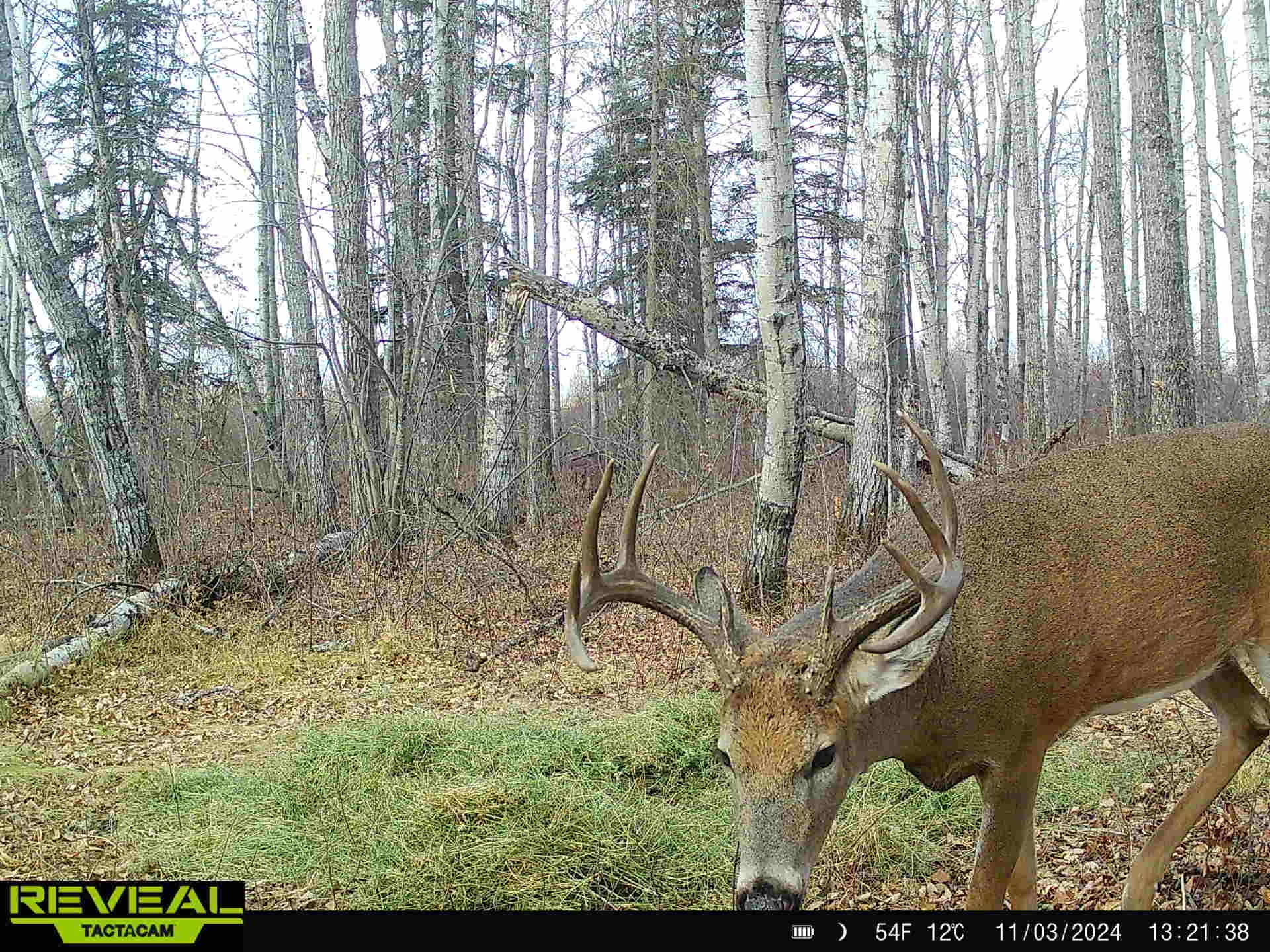
At Mistatim Outfitting, located on the forest fringe of East Central Saskatchewan near Hudson Bay, hunters have the opportunity to hunt Whitetail bucks with impressive body size and antler growth. A typical mature buck in our hunting territory can weigh approximately 250 to 300 pounds, with antlers commonly scoring in the 135- to 175-inch range. Exceptional bucks can exceed 175 inches, with the potential for truly outstanding animals approaching 200 inches.
So, why do Saskatchewan Whitetail grow so large at Mistatim Outfitting?
There isn't one single reason. It is the combination of northern genetics, abundant food, excellent forest-fringe habitat, harsh winters, and — perhaps most importantly — the opportunity for bucks to grow old.
What Makes Saskatchewan Whitetail So Big?
Saskatchewan is known for producing big-bodied Whitetail deer and some exceptional trophy bucks.
Several factors come together in the Mistatim area:
- Northern Whitetail genetics
- Abundant agricultural food sources
- Forest and bush cover
- Harsh winters that favor large-bodied deer
- Low hunting pressure
- Older age structure
- Excellent deer habitat along the forest fringe
Together, these conditions create an environment where a genetically capable buck can survive, mature and reach its physical potential.
1. Northern Genetics Play an Important Role
One of the biggest reasons Saskatchewan produces large Whitetail is genetics.
The Saskatchewan Ministry of Agriculture identifies the Dakota white-tailed deer as the subspecies found across the Northern Great Plains, including Western Canada. According to the province, the Dakota white-tail has the largest body and antler size of the recognized white-tailed deer subspecies. Its larger body and thick winter coat are adaptations that help it survive severe winter conditions.
That is an important starting point when talking about big Saskatchewan Whitetail deer.
Genetics establish a buck's potential. But genetics alone don't guarantee a trophy.
A buck needs the right combination of nutrition, habitat, age and survival to reach that potential.
That is where the Mistatim area becomes particularly interesting.
2. Saskatchewan Agriculture Provides an Excellent Food Source
Whitetail deer are incredibly adaptable animals, and Saskatchewan's agricultural landscape provides an important source of nutrition.
The forest fringe around Mistatim provides deer with access to both natural vegetation and agricultural food sources. The Saskatchewan government notes that agricultural crops such as cereal grains and alfalfa, combined with increased woody habitat, have helped support strong white-tailed deer populations across the province.
For a growing buck, nutrition is critical.
A deer requires energy and nutrients not only to maintain its body but also to grow muscle, develop bone and produce antlers.
The province specifically notes that food supply has a significant effect on survival, reproduction, body size and antler scores.
In other words, a buck with good genetics still needs good groceries.
The combination of agricultural fields and natural forest habitat gives Mistatim-area Whitetails access to a diverse environment throughout the year.
3. The Forest Fringe Provides Food and Security
Mistatim Outfitting operates in a unique forest-fringe environment, where agricultural land meets forest and bush.
This transition zone is excellent Whitetail habitat.
The agricultural areas provide valuable food, while the surrounding bush and forest provide bedding areas, security cover and protection from weather.
Whitetails don't necessarily have to choose between food and cover. In a forest-fringe environment, they can often have both relatively close together.
That creates the kind of habitat that allows deer to spend less energy traveling long distances and more time feeding, bedding and moving naturally through their home range.
For hunters, it also creates natural travel corridors between feeding and bedding areas.
4. Harsh Saskatchewan Winters Favor Big-Bodied Deer
Saskatchewan winters are not easy on wildlife.
Deep snow, cold temperatures and limited winter nutrition can place enormous demands on a Whitetail's body.
Interestingly, large body size can be an advantage in a northern climate.
The Saskatchewan government notes that the larger body size and thick haircoat of northern Dakota white-tailed deer help them endure severe winter weather.
A Whitetail also enters winter having built up energy reserves during the summer and fall.
This makes the annual cycle particularly important:
Spring → summer growth → fall feeding → winter survival → spring recovery
The bucks that consistently survive this cycle have the opportunity to become very large mature animals.
5. Low Hunting Pressure Gives Bucks Something Extremely Valuable: Time
This may be one of the most important factors at Mistatim Outfitting.
Time.
A buck cannot become a 6-, 7- or 8-year-old trophy if it is harvested when it is 2 or 3 years old.
According to Mistatim Outfitting, its Whitetail territory has experienced extremely low hunting pressure for approximately 10 years. That has allowed bucks to survive longer and reach an older age than they might in heavily hunted areas.
This is significant because age is one of the keys to trophy Whitetail potential.
As a buck matures, its body becomes larger and its antlers have additional opportunities to develop.
At Mistatim, mature bucks in the 150-inch-and-up class are commonly described as approximately 6.5 to 8.5 years old.
That means hunters aren't simply looking for young bucks with good genetics.
They are hunting in an area where some bucks have had the opportunity to survive long enough to become truly mature animals.
6. Mature Bucks Have the Opportunity to Reach Their Potential
A young buck may have excellent genetics but still have years of growth ahead of him.
This is why age structure is so important when evaluating a trophy Whitetail hunting area.
Imagine two areas with exactly the same genetics and food supply.
In Area A, bucks are heavily hunted and most are harvested at a young age.
In Area B, hunting pressure is low and more bucks survive into maturity.
Area B has a much better opportunity to produce older, heavier and more impressive bucks.
That is one of the major advantages of the Mistatim Outfitting hunting territory.
The objective isn't simply to find deer.
It is to hunt an area where mature deer have had the opportunity to survive.
7. A Healthy Combination of Food and Cover
Big Whitetail don't grow in isolation.
They need habitat that supports them throughout the year.
The Mistatim area offers a combination of:
- Agricultural fields
- Forest
- Bush
- Natural cover
- Deer travel corridors
- Feeding areas
- Bedding areas
- Protection from severe weather
The Saskatchewan government emphasizes that trees and shrubs are particularly important to wild white-tailed deer because they provide food, shelter and protection from severe winter conditions.
This combination of food and cover is one reason the forest fringe of Saskatchewan can be such productive Whitetail habitat.
How Big Are the Whitetail at Mistatim Outfitting?
Hunters often want to know what size deer they can realistically expect when planning a Saskatchewan Whitetail hunt.
At Mistatim Outfitting, a typical mature Whitetail buck can weigh approximately 250 to 300 pounds.
Antler size commonly falls in the 135- to 175-inch range, while mature trophy bucks can exceed 175 inches.
Exceptional deer have the potential to approach or exceed the 200-inch mark.
Of course, wild animals are unpredictable. No outfitter can guarantee the size of an individual buck.
The advantage is being in an area where the habitat, genetics, age structure and hunting pressure provide the opportunity for exceptional animals to exist.
Why Hunting Pressure Matters So Much
One of the biggest misconceptions about trophy Whitetail hunting is that you simply need a lot of deer.
You don't.
You need the right deer.
A property could have hundreds of Whitetails but relatively few mature bucks if hunting pressure removes the older animals.
Conversely, a territory with fewer deer can potentially produce excellent trophy opportunities if mature bucks are allowed to survive.
This is why low hunting pressure is so valuable.
At Mistatim Outfitting, approximately 10 years of very low hunting pressure has allowed bucks to move through multiple age classes and, importantly, has given some bucks the opportunity to reach advanced maturity.
Why Mistatim Is a Special Saskatchewan Whitetail Hunting Environment
The real answer to the question isn't one factor.
It's the combination.
Northern genetics provide the potential for large body size and antler growth.
Agricultural food sources provide valuable nutrition.
Forest and bush cover provide security and winter protection.
The forest-fringe environment puts food and cover together.
Saskatchewan's climate favors large-bodied northern deer.
And low hunting pressure gives bucks the most important ingredient of all: time.
When these factors come together, the result can be exactly what Saskatchewan Whitetail hunters dream about—a mature, heavy-bodied buck with impressive antlers.
Hunting Big Saskatchewan Whitetail at Mistatim Outfitting
At Mistatim Outfitting, our goal is to give hunters the best possible opportunity to pursue these mature Saskatchewan Whitetails.
Our territory is located on the forest fringe of East Central Saskatchewan near Hudson Bay and includes a mixture of farmland edges, deeper bush and natural deer travel corridors.
We use extensive pre-season scouting and trail-camera monitoring to identify the areas where mature bucks are most active. During the season, hunters can hunt from tree stands or ground blinds, including heated stands for additional comfort during Saskatchewan's cold fall weather.
Our operation maintains approximately 20 active Whitetail bait sites and uses 15 Tactacam trail cameras to monitor deer activity and help identify productive hunting locations.
The result is a guided Saskatchewan Whitetail hunt focused on giving hunters an opportunity at a mature trophy buck in a lightly hunted environment.
Frequently Asked Questions About Big Saskatchewan Whitetail
Why do Saskatchewan whitetail grow so large?
Saskatchewan Whitetail benefit from northern genetics, abundant agricultural food sources, forest and bush habitat, and a climate that favors large-bodied deer. At Mistatim Outfitting, very low hunting pressure also allows more bucks to survive to older ages and reach their physical and antler potential.
How big are Whitetail bucks at Mistatim Outfitting?
A typical mature buck in the Mistatim Outfitting territory can weigh approximately 250 to 300 pounds. Antlers commonly score between 135 and 175 inches, while exceptional bucks can exceed 175 inches and potentially approach 200 inches.
What makes Saskatchewan good for trophy Whitetail hunting?
Saskatchewan combines northern Whitetail genetics with agricultural food sources, forest cover and harsh winter conditions. These factors can produce large-bodied deer and provide the habitat necessary for mature bucks to survive and grow.
How important is age for a trophy Whitetail?
Age is extremely important. A buck needs to survive multiple hunting seasons before it can reach its full physical and antler potential. At Mistatim Outfitting, mature bucks in the 150-inch-and-up range are typically estimated to be approximately 6.5 to 8.5 years old.
Does low hunting pressure help produce bigger Whitetail?
Yes. Low hunting pressure gives bucks a greater opportunity to survive to older ages. Mistatim Outfitting's territory has experienced extremely low hunting pressure for nearly 10 years, allowing more bucks to mature.
Is Mistatim Outfitting located in good Saskatchewan Whitetail habitat?
Yes. Mistatim Outfitting is located on the forest fringe of East Central Saskatchewan near Hudson Bay. The hunting territory combines farmland edges, forest, bush and natural wildlife corridors.
What do Saskatchewan Whitetail eat?
Whitetail have a varied diet that changes throughout the year. Saskatchewan deer can take advantage of agricultural crops, grasses, forbs, shrubs, trees and other available vegetation. Agricultural crops can provide particularly valuable nutrition where farmland and natural habitat meet.
Can I hunt a big Saskatchewan Whitetail with a rifle?
Yes. Mistatim Outfitting offers guided rifle Whitetail hunts. Typical rifle shot opportunities at the outfitter's bait sites are approximately 75 to 110 yards, depending on the location and conditions.
Does Mistatim Outfitting offer archery Whitetail hunts?
Yes. Archery hunting is available, with hunters generally positioned approximately 30 to 35 yards from the bait at selected locations.
The Bottom Line
Why do Saskatchewan Whitetail grow so large at Mistatim Outfitting?
Because the conditions come together in a way that gives mature bucks the opportunity to reach their potential.
Good genetics + abundant food + excellent habitat + harsh northern conditions + low hunting pressure + old age = big Saskatchewan Whitetail.
And perhaps the most important part of that equation is age.
A buck can't become a true trophy if it doesn't survive long enough to mature.
At Mistatim Outfitting, hunters have the opportunity to pursue mature Saskatchewan Whitetails in a forest-fringe environment where bucks have experienced very low hunting pressure for nearly a decade.
For hunters dreaming of a big Saskatchewan Whitetail buck, that's a combination worth paying attention to.
Your Saskatchewan trophy Whitetail may be waiting in the bush.